## You have said it. Everyone has said it.
Your child is screaming. Maybe it is bedtime. Maybe it is the wrong cup, or the sock seam, or the fact that you broke the banana in half. The feelings are enormous and the volume is rising.
So you say the thing every parent says: "Take a deep breath."
And nothing happens. Or it gets worse.
You are not doing it wrong. That instruction is just landing in the wrong part of the brain at the wrong time.
Here is why, and what actually helps.
—
## What is happening in your child's brain during a meltdown
To understand why "take a deep breath" fails mid-meltdown, you need to know what is happening inside your child's head when they lose it.
The brain has two parts that matter here.
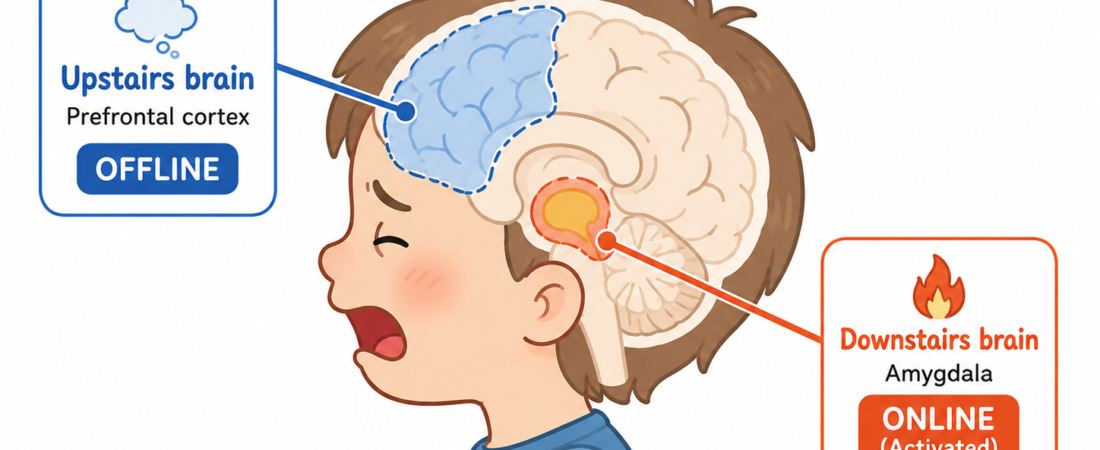
The **prefrontal cortex**, sometimes called the "upstairs brain", handles reasoning, decision-making, impulse control, and the ability to follow a verbal instruction like "breathe slowly." In young children, this part of the brain is still developing. It will not be fully mature until their mid-twenties.
The **amygdala**, sometimes called the "downstairs brain" or the brain's alarm system, detects threats and launches the body's survival response: fight, flight, or freeze. It does not think. It reacts. And it is fast.
When a child is overwhelmed, by frustration, sensory overload, exhaustion, or a feeling they cannot name, the amygdala takes over. Stress hormones like cortisol and adrenaline flood the body. The heart races. Breathing speeds up. Muscles tense.
And the prefrontal cortex? It goes offline.
This is not a figure of speech. During emotional flooding, the part of the brain that could follow your instruction to "take a deep breath" is genuinely less accessible. The child is not choosing to ignore you. Their brain has shifted into survival mode, and reasoning is temporarily unavailable.
—
## Why verbal instructions fail during overwhelm
"Take a deep breath" is a verbal, cognitive instruction. It requires a child to hear your words, understand what you are asking, recall the technique, and then voluntarily control their breathing, all while their nervous system is screaming that something is wrong.
That is a prefrontal cortex task. And during a meltdown, the prefrontal cortex is not running the show.
This is why telling a child to "calm down" during a tantrum often makes things worse. To a dysregulated brain, even a calm voice giving a reasonable instruction can register as more input to process, more noise, more demand, more overwhelm.
Child psychiatrist and neuroscientist Dr. Bruce Perry describes this with a framework called the Three Rs: **Regulate, Relate, Reason.** The sequence matters. You cannot reason with a child (or ask them to follow an instruction) until their body is regulated first. And you cannot relate to them until they feel safe.
Most parents, with the best intentions, skip straight to Reason. They say "calm down," "use your words," or "take a deep breath" because those sound like helpful things to say. But the child's brain is not ready for helpful words yet. It needs something more basic. It needs a sensory signal that says: you are safe.
—
## What actually works during a meltdown
If verbal instructions are not the answer mid-meltdown, what is?
The short answer: **your body, not your words.**
### Co-regulation comes first
Young children do not yet have the ability to regulate their emotions on their own. They rely on the adults around them to help bring their nervous system back down. This is called co-regulation, and it is the foundation of self-regulation later in life.
Co-regulation is not a technique you perform. It is a state you offer. It looks like staying physically close, keeping your own breathing steady, lowering your voice (or going quiet), and not escalating. Your calm nervous system helps signal to your child's nervous system that the danger is not real.
This is hard. Especially when you are exhausted and the meltdown is happening at 8:30 p.m. on a Tuesday. But it matters more than any instruction you could give.
### Sensory input over verbal input
Once you are regulated and present, sensory-based tools work better than words. The amygdala responds to physical cues, touch, pressure, rhythm, warmth, because those signals travel through the body's sensory pathways, not through the reasoning pathways that are currently offline.
Things that can help in the moment: a firm hug or gentle pressure, a soft blanket, rocking, humming, lowering the lights, or simply sitting beside your child without talking.
None of these require your child to think. That is the point.
### The technique has to be learned before the meltdown
Here is the part most parenting advice gets wrong.
Deep breathing does work. Grounding techniques do work. The 5-senses technique, noticing what you can see, hear, feel, smell, and taste, does work. These are real, evidence-backed tools for emotional regulation.
But they only work if the child has practiced them **before** they are upset.
A child who has never practiced slow breathing cannot suddenly access it during a meltdown. The neural pathway is not there yet. It has to be built through repetition, in calm moments, over time. Then, when the big feelings come, the body has a familiar path back to calm, one it can follow even when the thinking brain is not fully available.
This is why practice matters more than intervention. And it is why the practice window matters so much.
—
## Why bedtime is the best time to practice (not during the meltdown)
If the goal is to give your child a calming tool they can eventually use on their own, you need a time when their brain is calm, receptive, and open to learning. A time when the prefrontal cortex is online and the amygdala is not running the show.
For most families, that time is bedtime.
Not the meltdown moment. Not the transition from the park. Not the middle of a sibling conflict. Bedtime, when the lights are low, the house is quieter, and you are already sitting together.
And most families already have a bedtime ritual that creates this window: the bedtime story.
A [calming bedtime book](https://groundedpress.com) that includes a breathing exercise or a grounding technique gives your child a way to practice regulation without it feeling like a lesson. They are not doing an exercise. They are reading a story with you. And inside that story, their body is rehearsing a skill.
This is what makes practice stick. It is not about adding a new step to your routine. It is about putting the tool inside something you are already doing.
—
## What this looks like over time
The first time your child reads a [book with breathing exercises](https://groundedpress.com), they may just enjoy the story. That is fine.
The fifth time, they might start breathing along with the character without being asked.
The fifteenth time, they might place their hand on their belly during the breathing part because their body remembers.
And one night, not every night, but some night, when the big feelings come at bedtime, they might reach for that slow breath on their own. Not because you told them to. Because their body knows the way.
That is emotional regulation. Not a command. A practice. Built one bedtime story at a time.
—
## So what should you do the next time your child melts down?
You do not need to fix it. You do not need a script or a strategy card.
**During the meltdown:**
Stay close. Stay calm (as calm as you can). Reduce sensory input. Offer your presence, not your instructions. Wait for the wave to pass. Your regulated body is the most powerful tool you have in that moment.
**After the meltdown:**
Reconnect. Do not lecture. Do not rehash what happened. Just be together. This is where the relationship repairs itself.
**Before the next meltdown:**
This is where the real work happens. Practice a simple calming technique during a calm moment, like bedtime. Use a [calm down book for preschoolers](https://groundedpress.com) that builds the skill into the story. Let the repetition do the teaching.
The goal is not to prevent meltdowns. Young children will have them. That is developmentally normal. The goal is to give your child, and yourself, a path back to calm that the body already knows.
—
## It starts before the storm
Deep breathing works. Grounding works. But not if the first time your child tries it is in the middle of a crisis.
The calming skill has to be practiced when the brain is calm. It has to be repeated until the body remembers. And it has to feel simple enough that a tired parent and a wound-up toddler can actually do it together.
That is what [Grounded Press books](https://groundedpress.com) are built for. Each book uses the 5-senses grounding technique, woven into a bedtime story, so children can practice emotional regulation in the safest moment of their day, without it feeling like one more thing on the list.
**[Browse calming bedtime books from Grounded Press →](https://groundedpress.com)**
—
## Frequently Asked Questions
### Why doesn't "take a deep breath" work when my child is upset?
During a meltdown, the part of the brain that processes verbal instructions, the prefrontal cortex, becomes less accessible. The brain shifts into a survival response driven by the amygdala. Your child is not ignoring you. Their brain is temporarily unable to follow a cognitive instruction like "breathe slowly." The technique itself is valid, but it needs to be practiced during calm moments so the body can access it automatically when emotions are high.
### What is co-regulation and why does it matter?
Co-regulation is the process by which a calm adult helps a child's nervous system settle down. Young children cannot regulate their emotions on their own, they rely on the adults around them to model and share a calm state. Over time, repeated co-regulation helps children build the internal capacity for self-regulation. It is the foundation of emotional regulation development.
### What is the "Regulate, Relate, Reason" framework?
Developed by child psychiatrist Dr. Bruce Perry, this framework describes the sequence adults should follow when a child is dysregulated. First, help the child regulate (calm their body). Then, relate (connect emotionally). Only then can you reason (talk about what happened or what to do differently). Most parents skip to reasoning first, which is why verbal instructions often fail during meltdowns.
### When should I teach my child breathing or grounding techniques?
The best time to practice calming techniques is during a calm, connected moment, not during a meltdown. Bedtime is ideal because the child is already in a low-stimulation environment, the brain is receptive, and most families already have a story ritual in place. Repetition over time builds the neural pathways that allow a child to access the skill when they need it most.
### Can a bedtime book really help with meltdowns?
A calming bedtime book does not stop meltdowns in the moment. What it does is give children repeated practice with a body-based calming technique, like the 5-senses grounding exercise, in a calm setting. Over time, that practice helps children develop the ability to recognize their own overwhelm and use a familiar tool to move through it. The book is the practice. The skill builds from there.
You have said it. Everyone has said it.
Your child is screaming. Maybe it is bedtime. Maybe it is the wrong cup, or the sock seam, or the fact that you broke the banana in half. The feelings are enormous and the volume is rising.
So you say the thing every parent says: “Take a deep breath.”
And nothing happens. Or it gets worse.
You are not doing it wrong. That instruction is just landing in the wrong part of the brain at the wrong time.
Here is why, and what actually helps.
What is happening in your child’s brain during a meltdown
To understand why “take a deep breath” fails mid-meltdown, you need to know what is happening inside your child’s head when they lose it.
The brain has two parts that matter here.
The prefrontal cortex, sometimes called the “upstairs brain”, handles reasoning, decision-making, impulse control, and the ability to follow a verbal instruction like “breathe slowly.” In young children, this part of the brain is still developing. It will not be fully mature until their mid-twenties.
The amygdala, sometimes called the “downstairs brain” or the brain’s alarm system, detects threats and launches the body’s survival response: fight, flight, or freeze. It does not think. It reacts. And it is fast.
When a child is overwhelmed, by frustration, sensory overload, exhaustion, or a feeling they cannot name, the amygdala takes over. Stress hormones like cortisol and adrenaline flood the body. The heart races. Breathing speeds up. Muscles tense.
And the prefrontal cortex? It goes offline.
This is not a figure of speech. During emotional flooding, the part of the brain that could follow your instruction to “take a deep breath” is genuinely less accessible. The child is not choosing to ignore you. Their brain has shifted into survival mode, and reasoning is temporarily unavailable.
Why verbal instructions fail during overwhelm
“Take a deep breath” is a verbal, cognitive instruction. It requires a child to hear your words, understand what you are asking, recall the technique, and then voluntarily control their breathing, all while their nervous system is screaming that something is wrong.
That is a prefrontal cortex task. And during a meltdown, the prefrontal cortex is not running the show.
This is why telling a child to “calm down” during a tantrum often makes things worse. To a dysregulated brain, even a calm voice giving a reasonable instruction can register as more input to process, more noise, more demand, more overwhelm.
Child psychiatrist and neuroscientist Dr. Bruce Perry describes this with a framework called the Three Rs: Regulate, Relate, Reason. The sequence matters. You cannot reason with a child (or ask them to follow an instruction) until their body is regulated first. And you cannot relate to them until they feel safe.
Most parents, with the best intentions, skip straight to Reason. They say “calm down,” “use your words,” or “take a deep breath” because those sound like helpful things to say. But the child’s brain is not ready for helpful words yet. It needs something more basic. It needs a sensory signal that says: you are safe.
What actually works during a meltdown
If verbal instructions are not the answer mid-meltdown, what is?
The short answer: your body, not your words.
Co-regulation comes first
Young children do not yet have the ability to regulate their emotions on their own. They rely on the adults around them to help bring their nervous system back down. This is called co-regulation, and it is the foundation of self-regulation later in life.
Co-regulation is not a technique you perform. It is a state you offer. It looks like staying physically close, keeping your own breathing steady, lowering your voice (or going quiet), and not escalating. Your calm nervous system helps signal to your child’s nervous system that the danger is not real.
This is hard. Especially when you are exhausted and the meltdown is happening at 8:30 p.m. on a Tuesday. But it matters more than any instruction you could give.
Sensory input over verbal input
Once you are regulated and present, sensory-based tools work better than words. The amygdala responds to physical cues, touch, pressure, rhythm, warmth, because those signals travel through the body’s sensory pathways, not through the reasoning pathways that are currently offline.
Things that can help in the moment: a firm hug or gentle pressure, a soft blanket, rocking, humming, lowering the lights, or simply sitting beside your child without talking.
None of these require your child to think. That is the point.
The technique has to be learned before the meltdown
Here is the part most parenting advice gets wrong.
Deep breathing does work. Grounding techniques do work. The 5-senses technique, noticing what you can see, hear, feel, smell, and taste, does work. These are real, evidence-backed tools for emotional regulation.
But they only work if the child has practiced them before they are upset.
A child who has never practiced slow breathing cannot suddenly access it during a meltdown. The neural pathway is not there yet. It has to be built through repetition, in calm moments, over time. Then, when the big feelings come, the body has a familiar path back to calm, one it can follow even when the thinking brain is not fully available.
This is why practice matters more than intervention. And it is why the practice window matters so much.
Why bedtime is the best time to practice (not during the meltdown)
If the goal is to give your child a calming tool they can eventually use on their own, you need a time when their brain is calm, receptive, and open to learning. A time when the prefrontal cortex is online and the amygdala is not running the show.
For most families, that time is bedtime.
Not the meltdown moment. Not the transition from the park. Not the middle of a sibling conflict. Bedtime, when the lights are low, the house is quieter, and you are already sitting together.
And most families already have a bedtime ritual that creates this window: the bedtime story.
A calming bedtime book that includes a breathing exercise or a grounding technique gives your child a way to practice regulation without it feeling like a lesson. They are not doing an exercise. They are reading a story with you. And inside that story, their body is rehearsing a skill.
This is what makes practice stick. It is not about adding a new step to your routine. It is about putting the tool inside something you are already doing.
What this looks like over time
The first time your child reads a book with breathing exercises, they may just enjoy the story. That is fine.
The fifth time, they might start breathing along with the character without being asked.
The fifteenth time, they might place their hand on their belly during the breathing part because their body remembers.
And one night, not every night, but some night, when the big feelings come at bedtime, they might reach for that slow breath on their own. Not because you told them to. Because their body knows the way.
That is emotional regulation. Not a command. A practice. Built one bedtime story at a time.
So what should you do the next time your child melts down?
You do not need to fix it. You do not need a script or a strategy card.
During the meltdown:
Stay close. Stay calm (as calm as you can). Reduce sensory input. Offer your presence, not your instructions. Wait for the wave to pass. Your regulated body is the most powerful tool you have in that moment.
After the meltdown:
Reconnect. Do not lecture. Do not rehash what happened. Just be together. This is where the relationship repairs itself.
Before the next meltdown:
This is where the real work happens. Practice a simple calming technique during a calm moment, like bedtime. Use a calm down book for preschoolers that builds the skill into the story. Let the repetition do the teaching.
The goal is not to prevent meltdowns. Young children will have them. That is developmentally normal. The goal is to give your child, and yourself, a path back to calm that the body already knows.
It starts before the storm
Deep breathing works. Grounding works. But not if the first time your child tries it is in the middle of a crisis.
The calming skill has to be practiced when the brain is calm. It has to be repeated until the body remembers. And it has to feel simple enough that a tired parent and a wound-up toddler can actually do it together.
That is what Grounded Press books are built for. Each book uses the 5-senses grounding technique, woven into a bedtime story, so children can practice emotional regulation in the safest moment of their day, without it feeling like one more thing on the list.
Browse calming bedtime books from Grounded Press →
Frequently Asked Questions
Why doesn’t “take a deep breath” work when my child is upset?
During a meltdown, the part of the brain that processes verbal instructions, the prefrontal cortex, becomes less accessible. The brain shifts into a survival response driven by the amygdala. Your child is not ignoring you. Their brain is temporarily unable to follow a cognitive instruction like “breathe slowly.” The technique itself is valid, but it needs to be practiced during calm moments so the body can access it automatically when emotions are high.
What is co-regulation and why does it matter?
Co-regulation is the process by which a calm adult helps a child’s nervous system settle down. Young children cannot regulate their emotions on their own, they rely on the adults around them to model and share a calm state. Over time, repeated co-regulation helps children build the internal capacity for self-regulation. It is the foundation of emotional regulation development.
What is the “Regulate, Relate, Reason” framework?
Developed by child psychiatrist Dr. Bruce Perry, this framework describes the sequence adults should follow when a child is dysregulated. First, help the child regulate (calm their body). Then, relate (connect emotionally). Only then can you reason (talk about what happened or what to do differently). Most parents skip to reasoning first, which is why verbal instructions often fail during meltdowns.
When should I teach my child breathing or grounding techniques?
The best time to practice calming techniques is during a calm, connected moment, not during a meltdown. Bedtime is ideal because the child is already in a low-stimulation environment, the brain is receptive, and most families already have a story ritual in place. Repetition over time builds the neural pathways that allow a child to access the skill when they need it most.
Can a bedtime book really help with meltdowns?
A calming bedtime book does not stop meltdowns in the moment. What it does is give children repeated practice with a body-based calming technique, like the 5-senses grounding exercise, in a calm setting. Over time, that practice helps children develop the ability to recognize their own overwhelm and use a familiar tool to move through it. The book is the practice. The skill builds from there.