**By Biana Rivero Kuzmina, RN, BSN**
It's 9 PM. Bedtime was supposed to be an hour ago.
Your toddler is not crying. They're doing laps around the living room in footie pajamas like it's the middle of the morning. They're laughing, bringing you toys, asking questions, ready to start a whole new day.
You did the bath. You did the pajamas. You dimmed the lights. You did everything right. And now you're sitting there wondering what you did wrong today. Was it the late nap? The birthday party? Too much screen time?
You didn't do anything wrong. This is what an overstimulated nervous system looks like in a toddler — and it's not what most parents expect.
## The short answer
Your toddler's brain can't find the off switch. The prefrontal cortex, the part of the brain that says "the day is over, time to power down," isn't fully built yet. It won't be for years (Tottenham & Galván, 2016). So after a big day full of noise, activity, and sensory input, their nervous system stays stuck on high. In toddlers, that doesn't always look like a meltdown. It often looks like a kid who is suddenly, inexplicably wired (Capanna-Hodge, 2026).
They're not wired because they aren't tired. They're wired because they're too tired and too stimulated for their body to find the brake.
You can't talk them out of it. You can't instruct them into being sleepy. The calming has to come through their body.
Here's what you can do tonight.
## What actually works
**Slow your own body first.** Your toddler's nervous system is reading yours. If you're tense and rushing through the routine to get it over with, their body matches that. Drop your shoulders. Slow your breathing. Lower your voice. Children ages 1 to 3 regulate through co-regulation — they borrow calm from the adult holding them (Tottenham & Galván, 2016). You are the tool.
**Cut the stimulation.** Don't add more. Take things away. Overhead lights off. TV off, even in another room. The goal is to shrink the amount of information their nervous system is processing. Darkness triggers melatonin. Quiet tells their body it's safe to stop scanning.
**Use rhythm and repetition.** Rocking, swaying, repetitive phrases, the same song every night. Rhythmic input helps regulate the brainstem, the part of the brain that controls basic activation (Bristol Child Parent Support, 2025). This is why rocking has worked for every generation of parents. It's not a trend. It's how the nervous system is built. Their body calms down when it knows what's coming next.
**Give them something physical to do.** A small, contained, sensory outlet. Tracing a path on a page or on your hand. Breathing with a stuffed animal on their belly so they can watch it rise and fall. Squeezing something soft. These give their body something to do while the nervous system comes down.
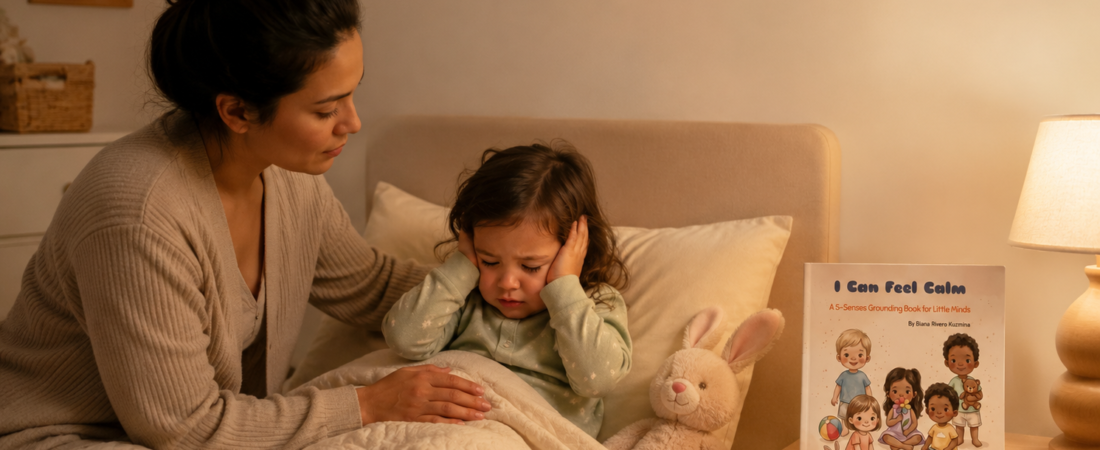
**Read a calming book with the practice built in.** Not just any bedtime story. Most bedtime books entertain but don't regulate. A book with breathing prompts, tracing paths, and repetitive calming language gives your child's body a way to practice slowing down without being told to slow down. The calming is in the reading. You don't teach anything. You just read the words on the page. That's why I built [*I Can Feel Calm*](https://groundedpressco.com/books#5senses) the way I did.
## You're not just surviving bedtime. You're building a lifelong skill.
Think about how you learned math. Nobody handed you a multiplication table once and expected you to know it. You practiced. Flash cards. Worksheets. The same problems, the same answers, over and over until one day your brain just knew.
Self-regulation works the same way. These skills are best learned in a calm state of mind and need a lot of repetition before a child can use them when it counts (Kids Mental Health Foundation, 2025). The boring Tuesday night when everything is fine? That's the practice ground. You read the book. They breathe along. They trace the page. Their body starts to associate that routine with safety.
Then, when the hard night comes — and it will — their body has a memory to fall back on.
Repetition physically changes the brain. Regularly practicing grounding strengthens the neural pathways that help reduce stress hormones and support self-regulation (Sanford Health, 2026). Over time, kids start using these skills in the car, before school, during hard transitions — in moments you'll never see. Not because you told them to. Because their body remembers.
You're not just getting through tonight. You're giving your child something most adults wish they'd learned as kids.
## Stop replaying the day
You're going to lie in bed tonight running through every decision. The sugar. The nap. The screen time. The playground.
Stop.
You didn't break your child's bedtime. They had a full day, and their immature nervous system didn't have the wiring to switch off smoothly. That's developmental neuroscience, not bad parenting.
Big days make for wired nights. The goal isn't to prevent every overstimulated evening. The goal is to have one simple, repeatable tool that helps their body come down when it happens. Not a calm-down corner with laminated cards they can't read. Not an app. Not a $45 essential oil diffuser.
One book. One routine. Every night. That's it.
—
## FAQ
**Why is my toddler so hyper at bedtime?**
After a day full of sensory input, a toddler's nervous system can get stuck in an activated state. Their prefrontal cortex isn't developed enough to switch it off, so instead of crashing, they get a second wind that looks like energy but is actually overstimulation.
**How do I calm an overstimulated toddler without a screen?**
Start by regulating your own body — your toddler mirrors your nervous system. Then reduce sensory input (lights, noise), use rhythmic repetition (rocking, same phrases, same book), and give them something physical to do like tracing or belly breathing with a stuffed animal.
**What's the difference between overtired and overstimulated?**
They often overlap. An overtired child missed their sleep window. An overstimulated child absorbed more sensory and emotional input than their nervous system could process. Both can look like a wired, hyper kid at bedtime. The approach is the same: body-based calming, not instructions.
**Do calming books actually work for toddlers?**
A calming book with built-in breathing prompts and repetitive sensory cues can help activate the parasympathetic nervous system, which slows heart rate and signals safety. The key is repetition — reading the same calming book regularly builds the neural pathways for self-regulation over time.
**When should I start using calming bedtime books?**
As early as you're reading bedtime stories. Toddlers and preschoolers benefit from body-based calming tools embedded in routines they already do. The earlier you start, the more practice their nervous system gets before they need the skill during a hard moment.
—
## References
Brain Balance Centers. (2026). *The science behind emotional dysregulation*. https://www.brainbalancecenters.com/blog/the-science-behind-emotional-dysregulation
Bristol Child Parent Support. (2025, December 2). *7 five minute vagal tone calm down exercises*. https://bristolchildparentsupport.co.uk/7-five-minute-vagal-tone-calm-down-exercises/
Capanna-Hodge, R. (2026). *Overstimulated and understimulated: Understanding nervous system dysregulation in children*. Dr. Roseann Capanna-Hodge. https://drroseann.com/post/overstimulated-and-understimulated
Kids Mental Health Foundation. (2025, March 1). *Helping kids cope with strong emotions*. https://www.kidsmentalhealthfoundation.org/mental-health-resources/behaviors-and-emotions/coping-with-strong-emotions
Sanford Health. (2026, February 23). *The importance of grounding techniques for kids: A simple guide for caregivers*. Sanford Fit. https://fit.sanfordhealth.org/blog/the-importance-of-grounding-techniques-for-kids-a-simple-guide-for-caregivers
Tottenham, N., & Galván, A. (2016). Stress and the adolescent brain: Amygdala-prefrontal cortex circuitry and ventral striatum as developmental targets. *Neuroscience & Biobehavioral Reviews, 70*, 217–227. https://doi.org/10.1016/j.neubiorev.2016.07.030
By Biana Rivero Kuzmina, RN, BSN
It’s 9 PM. Bedtime was supposed to be an hour ago.
Your toddler is not crying. They’re doing laps around the living room in footie pajamas like it’s the middle of the morning. They’re laughing, bringing you toys, asking questions, ready to start a whole new day.
You did the bath. You did the pajamas. You dimmed the lights. You did everything right. And now you’re sitting there wondering what you did wrong today. Was it the late nap? The birthday party? Too much screen time?
You didn’t do anything wrong. This is what an overstimulated nervous system looks like in a toddler — and it’s not what most parents expect.
The short answer
Your toddler’s brain can’t find the off switch. The prefrontal cortex, the part of the brain that says “the day is over, time to power down,” isn’t fully built yet. It won’t be for years (Tottenham & Galván, 2016). So after a big day full of noise, activity, and sensory input, their nervous system stays stuck on high. In toddlers, that doesn’t always look like a meltdown. It often looks like a kid who is suddenly, inexplicably wired (Capanna-Hodge, 2026).
They’re not wired because they aren’t tired. They’re wired because they’re too tired and too stimulated for their body to find the brake.
You can’t talk them out of it. You can’t instruct them into being sleepy. The calming has to come through their body.
Here’s what you can do tonight.
What actually works
Slow your own body first. Your toddler’s nervous system is reading yours. If you’re tense and rushing through the routine to get it over with, their body matches that. Drop your shoulders. Slow your breathing. Lower your voice. Children ages 1 to 3 regulate through co-regulation — they borrow calm from the adult holding them (Tottenham & Galván, 2016). You are the tool.
Cut the stimulation. Don’t add more. Take things away. Overhead lights off. TV off, even in another room. The goal is to shrink the amount of information their nervous system is processing. Darkness triggers melatonin. Quiet tells their body it’s safe to stop scanning.
Use rhythm and repetition. Rocking, swaying, repetitive phrases, the same song every night. Rhythmic input helps regulate the brainstem, the part of the brain that controls basic activation (Bristol Child Parent Support, 2025). This is why rocking has worked for every generation of parents. It’s not a trend. It’s how the nervous system is built. Their body calms down when it knows what’s coming next.
Give them something physical to do. A small, contained, sensory outlet. Tracing a path on a page or on your hand. Breathing with a stuffed animal on their belly so they can watch it rise and fall. Squeezing something soft. These give their body something to do while the nervous system comes down.
Read a calming book with the practice built in. Not just any bedtime story. Most bedtime books entertain but don’t regulate. A book with breathing prompts, tracing paths, and repetitive calming language gives your child’s body a way to practice slowing down without being told to slow down. The calming is in the reading. You don’t teach anything. You just read the words on the page. That’s why I built I Can Feel Calm the way I did.
You’re not just surviving bedtime. You’re building a lifelong skill.
Think about how you learned math. Nobody handed you a multiplication table once and expected you to know it. You practiced. Flash cards. Worksheets. The same problems, the same answers, over and over until one day your brain just knew.
Self-regulation works the same way. These skills are best learned in a calm state of mind and need a lot of repetition before a child can use them when it counts (Kids Mental Health Foundation, 2025). The boring Tuesday night when everything is fine? That’s the practice ground. You read the book. They breathe along. They trace the page. Their body starts to associate that routine with safety.
Then, when the hard night comes — and it will — their body has a memory to fall back on.
Repetition physically changes the brain. Regularly practicing grounding strengthens the neural pathways that help reduce stress hormones and support self-regulation (Sanford Health, 2026). Over time, kids start using these skills in the car, before school, during hard transitions — in moments you’ll never see. Not because you told them to. Because their body remembers.
You’re not just getting through tonight. You’re giving your child something most adults wish they’d learned as kids.
Stop replaying the day
You’re going to lie in bed tonight running through every decision. The sugar. The nap. The screen time. The playground.
Stop.
You didn’t break your child’s bedtime. They had a full day, and their immature nervous system didn’t have the wiring to switch off smoothly. That’s developmental neuroscience, not bad parenting.
Big days make for wired nights. The goal isn’t to prevent every overstimulated evening. The goal is to have one simple, repeatable tool that helps their body come down when it happens. Not a calm-down corner with laminated cards they can’t read. Not an app. Not a $45 essential oil diffuser.
One book. One routine. Every night. That’s it.
FAQ
Why is my toddler so hyper at bedtime?
After a day full of sensory input, a toddler’s nervous system can get stuck in an activated state. Their prefrontal cortex isn’t developed enough to switch it off, so instead of crashing, they get a second wind that looks like energy but is actually overstimulation.
How do I calm an overstimulated toddler without a screen?
Start by regulating your own body — your toddler mirrors your nervous system. Then reduce sensory input (lights, noise), use rhythmic repetition (rocking, same phrases, same book), and give them something physical to do like tracing or belly breathing with a stuffed animal.
What’s the difference between overtired and overstimulated?
They often overlap. An overtired child missed their sleep window. An overstimulated child absorbed more sensory and emotional input than their nervous system could process. Both can look like a wired, hyper kid at bedtime. The approach is the same: body-based calming, not instructions.
Do calming books actually work for toddlers?
A calming book with built-in breathing prompts and repetitive sensory cues can help activate the parasympathetic nervous system, which slows heart rate and signals safety. The key is repetition — reading the same calming book regularly builds the neural pathways for self-regulation over time.
When should I start using calming bedtime books?
As early as you’re reading bedtime stories. Toddlers and preschoolers benefit from body-based calming tools embedded in routines they already do. The earlier you start, the more practice their nervous system gets before they need the skill during a hard moment.
References
Brain Balance Centers. (2026). The science behind emotional dysregulation. https://www.brainbalancecenters.com/blog/the-science-behind-emotional-dysregulation
Bristol Child Parent Support. (2025, December 2). 7 five minute vagal tone calm down exercises. https://bristolchildparentsupport.co.uk/7-five-minute-vagal-tone-calm-down-exercises/
Capanna-Hodge, R. (2026). Overstimulated and understimulated: Understanding nervous system dysregulation in children. Dr. Roseann Capanna-Hodge. https://drroseann.com/post/overstimulated-and-understimulated
Kids Mental Health Foundation. (2025, March 1). Helping kids cope with strong emotions. https://www.kidsmentalhealthfoundation.org/mental-health-resources/behaviors-and-emotions/coping-with-strong-emotions
Sanford Health. (2026, February 23). The importance of grounding techniques for kids: A simple guide for caregivers. Sanford Fit. https://fit.sanfordhealth.org/blog/the-importance-of-grounding-techniques-for-kids-a-simple-guide-for-caregivers
Tottenham, N., & Galván, A. (2016). Stress and the adolescent brain: Amygdala-prefrontal cortex circuitry and ventral striatum as developmental targets. Neuroscience & Biobehavioral Reviews, 70, 217–227. https://doi.org/10.1016/j.neubiorev.2016.07.030