<p><strong>By Biana Rivero Kuzmina, RN, BSN</strong></p>
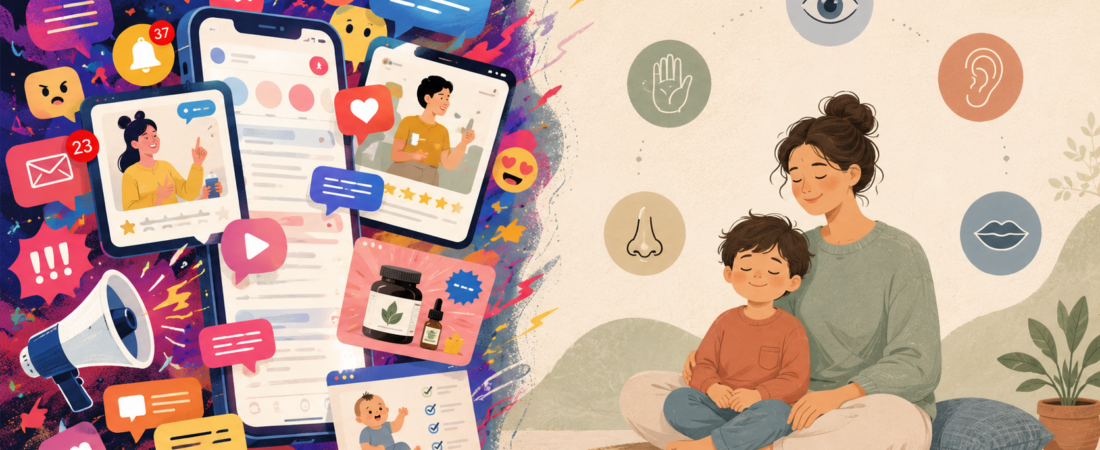
<p>Social media is giving me genuine anxiety. And I literally work in this space. The parenting advice overwhelm is real, and it’s not just me. The moment you open any app or lightly touch anything related to parenting, how to handle toddler meltdowns, what to do when your child won’t calm down, which gentle parenting script to memorize, it’s like piranhas attacking. Everyone wants a piece of your story, your timeline, your choices.</p>
<p>Every post is another expert telling you you’re doing it wrong.</p>
<p>Every comment section is a courtroom.</p>
<p>Every reel is a new protocol you’re supposed to memorize before breakfast.</p>
<p>With every piece of advice I absorb, I feel less like a parent and more like I’m supposed to be a licensed therapist and a credentialed schoolteacher just to raise my own kid.</p>
<p>When did it become not okay to just be human?</p>
<p><strong>The Research Says What You Already Feel</strong></p>
<p>The parenting advice overwhelm you feel at 10 PM isn’t weakness. The data backs it up.</p>
<p>Research on over 3,500 women found that social media use, social comparison, and the pressure to “do it all” were all correlated with higher levels of parental burnout (Black et al., 2022). The more you scroll, the more you compare. The more you compare, the more you burn out.</p>
<p>A study on mothers of young children found that engagement with parenting influencers on Instagram was associated with higher anxiety, particularly for mothers who were already prone to comparing themselves to others (Verrier & Moujaes, 2021). Another study found that following mommy influencers was associated with higher envy and lower perceived parental competence (Lee et al., 2025).</p>
<p>And a systematic review examining the rise of mom-influencers, which has increased by over 100% in the past five years, found that even “non-idealized” motherhood content triggers social comparison, resulting in higher anxiety and lower life satisfaction among mothers who consume it (Praveen & Dharani, 2025).</p>
<p>So, when I say the parenting internet is making us worse parents? That’s not a hot take. That’s the literature.</p>
<p><strong>The Advice Machine Doesn’t Want You to Feel Capable</strong></p>
<p>Here’s the part that keeps me up at night.</p>
<p>I wrote about this in my last article on the consumption trap in parenting (Kuzmina, 2026a). The parenting advice ecosystem doesn’t actually want you to feel like you’ve got this. Because the moment you feel capable, you stop scrolling. You stop buying. You stop clicking.</p>
<p>Over 70% of parents now say raising children is unaffordable (Wheatley Institute, 2026). And yet the solution the internet keeps offering is: buy more. Learn more. Do more. Be more.</p>
<p>More sensory kits. More calming corners. More courses. More scripts.</p>
<p>And when your toddler still has a full-body meltdown at bedtime, you’re left thinking you didn’t buy the right thing.</p>
<p>You did nothing wrong. The model is broken.</p>
<p><strong>Not Every Meltdown Needs a 12-Step Protocol</strong></p>
<p>I’m a registered nurse. I wrote a children’s book built around an actual evidence-based grounding technique. I care deeply about giving kids real tools for emotional regulation.</p>
<p>And even I look at the state of parenting content online and think: this is doing more harm than good.</p>
<p>As I discussed in my article on toddler emotional regulation and the future healthcare crisis (Kuzmina, 2026b), the real problem isn’t that parents lack information. It’s that parents are drowning in information and starving for something that actually works. We’ve replaced practice with products. We’ve replaced instinct with scripts. We’ve given kids tools without training.</p>
<p>Children don’t need perfection. They don’t need a parent who has memorized seventeen emotional regulation frameworks.</p>
<p>They need a parent who is present. Who stays calm enough. Who has one or two simple things that actually work when it matters.</p>
<p><strong>One Technique. Five Senses. Done.</strong></p>
<p>That’s why I built my book, <em>I Can Feel Calm: A 5-Senses Grounding Book for Little Minds</em>, around the 5-4-3-2-1 grounding technique, a sensory grounding exercise used in clinical settings for anxiety, panic, and emotional overwhelm.</p>
<p>Five things you can see. Four things you can touch. Three things you can hear. Two things you can smell. One thing you can taste.</p>
<p>Five senses. Done. Back to being a kid.</p>
<p>Grounding works because it sends calming sensory input to the brain, signaling safety (Sanford Health, 2026). Regularly practicing grounding strengthens brain regions that help reduce stress hormones and support critical thinking and communication (Sanford Health, 2026).</p>
<p>But here’s what most parenting content skips: the best time to learn emotion regulation is not in the middle of a strong emotion. These skills are best learned in a calm state of mind and require a lot of practice (Kids Mental Health Foundation, 2025).</p>
<p>You practice at bedtime. In the car. When things are fine.</p>
<p>So when things aren’t fine, their body remembers.</p>
<p><strong>We Don’t Need More Noise</strong></p>
<p>The antidote to parenting advice overwhelm isn’t more advice. It’s fewer, simpler tools that parents can actually remember at 7 AM when everything is falling apart.</p>
<p>Not another Instagram carousel telling you you’re doing it wrong.</p>
<p>Not another $99 course that makes you feel like you need a degree in child psychology to get through the day.</p>
<p>A book that costs less than one overhyped sensory bin. A technique your kid can take with them wherever they go. A practice that takes five minutes and costs nothing.</p>
<p>If you’re a parent who is tired of feeling like the internet is grading your every move, you’re not alone. And you’re not failing.</p>
<p>You’re just overwhelmed by a system that profits from making you feel like you’re never doing enough.</p>
<p>Pick one tool. Learn it. Practice it.</p>
<p>That’s enough.</p>
<p><strong>References</strong></p>
<p>Black, K. J., Cunningham, C. J. L., Gillespie, D. L., & Wyatt, K. D. (2022). Understudied social influences on work-related and parental burnout: Social media-related emotions, comparisons, and the “do it all discrepancy.” <em>Frontiers in Psychology, 13</em>, 977782. <a href="https://doi.org/10.3389/fpsyg.2022.977782">https://doi.org/10.3389/fpsyg.2022.977782</a></p>
<p>Kids Mental Health Foundation. (2025, March 1). <em>Helping kids cope with strong emotions</em>. <a href="https://www.kidsmentalhealthfoundation.org/mental-health-resources/behaviors-and-emotions/coping-with-strong-emotions">https://www.kidsmentalhealthfoundation.org/mental-health-resources/behaviors-and-emotions/coping-with-strong-emotions</a></p>
<p>Kuzmina, B. R. (2026a). You don’t need more stuff. Your kid needs to feel safe. <em>Grounded Press</em>. <a href="https://groundedpressco.com/you-dont-need-more-stuff-your-kid-needs-to-feel-safe">https://groundedpressco.com/you-dont-need-more-stuff-your-kid-needs-to-feel-safe</a></p>
<p>Kuzmina, B. R. (2026b). Toddler emotional regulation skills and the future healthcare crisis. <em>Grounded Press</em>. <a href="https://groundedpressco.com/toddler-emotional-regulation-skills-and-the-future-healthcare-crisis">https://groundedpressco.com/toddler-emotional-regulation-skills-and-the-future-healthcare-crisis</a></p>
<p>Lee, J. A., Cho, Y., Jung, Y., Kim, J., & Sung, Y. (2025). Social comparison on Instagram among millennial mothers: The relationships between envy and parental stress. <em>New Media & Society, 27</em>(3). <a href="https://doi.org/10.1177/14614448241243098">https://doi.org/10.1177/14614448241243098</a></p>
<p>Praveen, S. M., & Dharani, M. (2025). Navigating the digital sphere: A systematic review of the impact of parenting-based social media influencers on maternal mental health and child commercialization. <em>Contemporary Family Therapy</em>. <a href="https://doi.org/10.1177/09731342251340521">https://doi.org/10.1177/09731342251340521</a></p>
<p>Sanford Health. (2026, February 23). <em>The importance of grounding techniques for kids: A simple guide for caregivers</em>. Sanford Fit. <a href="https://fit.sanfordhealth.org/blog/the-importance-of-grounding-techniques-for-kids-a-simple-guide-for-caregivers">https://fit.sanfordhealth.org/blog/the-importance-of-grounding-techniques-for-kids-a-simple-guide-for-caregivers</a></p>
<p>Verrier, D., & Moujaes, M. (2021). Instagram use, InstaMums, and anxiety in mothers of young children. <em>Journal of Media Psychology, 33</em>(2), 72–81. <a href="https://doi.org/10.1027/1864-1105/a000282">https://doi.org/10.1027/1864-1105/a000282</a></p>
<p>Wheatley Institute. (2026, February 20). <em>2025 American family survey</em>. BYU College of Family, Home, and Social Sciences. <a href="https://socialsciences.byu.edu/2025-american-family-survey-economic-crisis-and-online-protection-for-children-define-new-challenges-for-american-families">https://socialsciences.byu.edu/2025-american-family-survey-economic-crisis-and-online-protection-for-children-define-new-challenges-for-american-families</a></p>
<p></p>
By Biana Rivero Kuzmina, RN, BSN
Social media is giving me genuine anxiety. And I literally work in this space. The parenting advice overwhelm is real, and it’s not just me. The moment you open any app or lightly touch anything related to parenting, how to handle toddler meltdowns, what to do when your child won’t calm down, which gentle parenting script to memorize, it’s like piranhas attacking. Everyone wants a piece of your story, your timeline, your choices.
Every post is another expert telling you you’re doing it wrong.
Every comment section is a courtroom.
Every reel is a new protocol you’re supposed to memorize before breakfast.
With every piece of advice I absorb, I feel less like a parent and more like I’m supposed to be a licensed therapist and a credentialed schoolteacher just to raise my own kid.
When did it become not okay to just be human?
The Research Says What You Already Feel
The parenting advice overwhelm you feel at 10 PM isn’t weakness. The data backs it up.
Research on over 3,500 women found that social media use, social comparison, and the pressure to “do it all” were all correlated with higher levels of parental burnout (Black et al., 2022). The more you scroll, the more you compare. The more you compare, the more you burn out.
A study on mothers of young children found that engagement with parenting influencers on Instagram was associated with higher anxiety, particularly for mothers who were already prone to comparing themselves to others (Verrier & Moujaes, 2021). Another study found that following mommy influencers was associated with higher envy and lower perceived parental competence (Lee et al., 2025).
And a systematic review examining the rise of mom-influencers, which has increased by over 100% in the past five years, found that even “non-idealized” motherhood content triggers social comparison, resulting in higher anxiety and lower life satisfaction among mothers who consume it (Praveen & Dharani, 2025).
So, when I say the parenting internet is making us worse parents? That’s not a hot take. That’s the literature.
The Advice Machine Doesn’t Want You to Feel Capable
Here’s the part that keeps me up at night.
I wrote about this in my last article on the consumption trap in parenting (Kuzmina, 2026a). The parenting advice ecosystem doesn’t actually want you to feel like you’ve got this. Because the moment you feel capable, you stop scrolling. You stop buying. You stop clicking.
Over 70% of parents now say raising children is unaffordable (Wheatley Institute, 2026). And yet the solution the internet keeps offering is: buy more. Learn more. Do more. Be more.
More sensory kits. More calming corners. More courses. More scripts.
And when your toddler still has a full-body meltdown at bedtime, you’re left thinking you didn’t buy the right thing.
You did nothing wrong. The model is broken.
Not Every Meltdown Needs a 12-Step Protocol
I’m a registered nurse. I wrote a children’s book built around an actual evidence-based grounding technique. I care deeply about giving kids real tools for emotional regulation.
And even I look at the state of parenting content online and think: this is doing more harm than good.
As I discussed in my article on toddler emotional regulation and the future healthcare crisis (Kuzmina, 2026b), the real problem isn’t that parents lack information. It’s that parents are drowning in information and starving for something that actually works. We’ve replaced practice with products. We’ve replaced instinct with scripts. We’ve given kids tools without training.
Children don’t need perfection. They don’t need a parent who has memorized seventeen emotional regulation frameworks.
They need a parent who is present. Who stays calm enough. Who has one or two simple things that actually work when it matters.
One Technique. Five Senses. Done.
That’s why I built my book, I Can Feel Calm: A 5-Senses Grounding Book for Little Minds, around the 5-4-3-2-1 grounding technique, a sensory grounding exercise used in clinical settings for anxiety, panic, and emotional overwhelm.
Five things you can see. Four things you can touch. Three things you can hear. Two things you can smell. One thing you can taste.
Five senses. Done. Back to being a kid.
Grounding works because it sends calming sensory input to the brain, signaling safety (Sanford Health, 2026). Regularly practicing grounding strengthens brain regions that help reduce stress hormones and support critical thinking and communication (Sanford Health, 2026).
But here’s what most parenting content skips: the best time to learn emotion regulation is not in the middle of a strong emotion. These skills are best learned in a calm state of mind and require a lot of practice (Kids Mental Health Foundation, 2025).
You practice at bedtime. In the car. When things are fine.
So when things aren’t fine, their body remembers.
We Don’t Need More Noise
The antidote to parenting advice overwhelm isn’t more advice. It’s fewer, simpler tools that parents can actually remember at 7 AM when everything is falling apart.
Not another Instagram carousel telling you you’re doing it wrong.
Not another $99 course that makes you feel like you need a degree in child psychology to get through the day.
A book that costs less than one overhyped sensory bin. A technique your kid can take with them wherever they go. A practice that takes five minutes and costs nothing.
If you’re a parent who is tired of feeling like the internet is grading your every move, you’re not alone. And you’re not failing.
You’re just overwhelmed by a system that profits from making you feel like you’re never doing enough.
Pick one tool. Learn it. Practice it.
That’s enough.
References
Black, K. J., Cunningham, C. J. L., Gillespie, D. L., & Wyatt, K. D. (2022). Understudied social influences on work-related and parental burnout: Social media-related emotions, comparisons, and the “do it all discrepancy.” Frontiers in Psychology, 13, 977782. https://doi.org/10.3389/fpsyg.2022.977782
Kids Mental Health Foundation. (2025, March 1). Helping kids cope with strong emotions. https://www.kidsmentalhealthfoundation.org/mental-health-resources/behaviors-and-emotions/coping-with-strong-emotions
Kuzmina, B. R. (2026a). You don’t need more stuff. Your kid needs to feel safe. Grounded Press. https://groundedpressco.com/you-dont-need-more-stuff-your-kid-needs-to-feel-safe
Kuzmina, B. R. (2026b). Toddler emotional regulation skills and the future healthcare crisis. Grounded Press. https://groundedpressco.com/toddler-emotional-regulation-skills-and-the-future-healthcare-crisis
Lee, J. A., Cho, Y., Jung, Y., Kim, J., & Sung, Y. (2025). Social comparison on Instagram among millennial mothers: The relationships between envy and parental stress. New Media & Society, 27(3). https://doi.org/10.1177/14614448241243098
Praveen, S. M., & Dharani, M. (2025). Navigating the digital sphere: A systematic review of the impact of parenting-based social media influencers on maternal mental health and child commercialization. Contemporary Family Therapy. https://doi.org/10.1177/09731342251340521
Sanford Health. (2026, February 23). The importance of grounding techniques for kids: A simple guide for caregivers. Sanford Fit. https://fit.sanfordhealth.org/blog/the-importance-of-grounding-techniques-for-kids-a-simple-guide-for-caregivers
Verrier, D., & Moujaes, M. (2021). Instagram use, InstaMums, and anxiety in mothers of young children. Journal of Media Psychology, 33(2), 72–81. https://doi.org/10.1027/1864-1105/a000282
Wheatley Institute. (2026, February 20). 2025 American family survey. BYU College of Family, Home, and Social Sciences. https://socialsciences.byu.edu/2025-american-family-survey-economic-crisis-and-online-protection-for-children-define-new-challenges-for-american-families