
The parenting internet makes you think you’re failing.
Not enough screen time limits. Not enough extracurricular activities. Not enough themed birthday parties (Bump, 2025). Not gentle enough. Too gentle. Too many complicated chore charts (Scary Mommy, 2025). Not aesthetic enough.
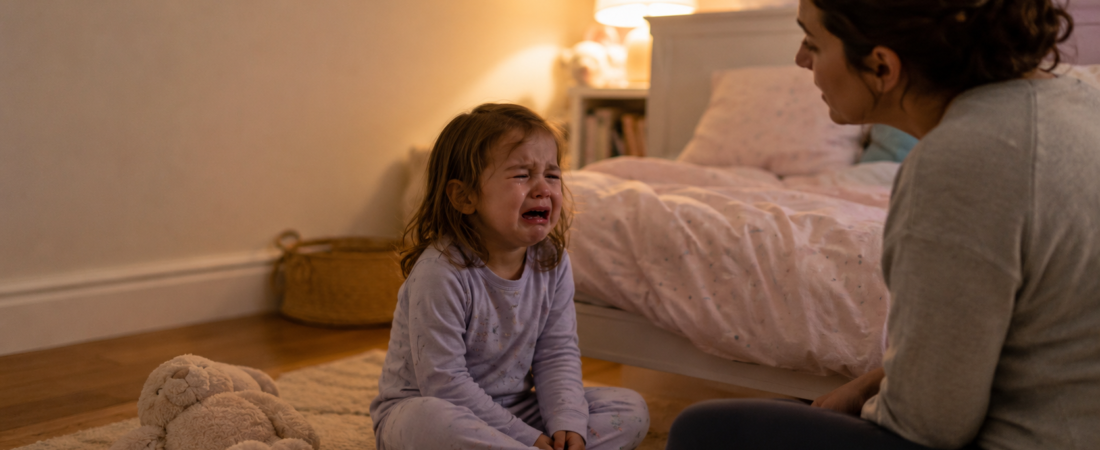
Amid all that noise, your kid is melting down at bedtime again.
Here’s what nobody’s saying: over 70% of parents now believe raising children is unaffordable (Wheatley Institute, 2026). The pressure to buy more, do more, and be more leaves parents feeling manipulated into endless consumption while their kids are just trying to survive Tuesday.
The Trap Nobody Talks About
Consumerism depends on your desire to buy things, even if it hurts you financially or psychologically (MasterClass, n.d.). The parenting version? Buy this sensory kit. This calming corner setup. This Montessori shelf. This gentle parenting course. This behavior chart system.
And when your toddler still has a full-body meltdown in the cereal aisle, you’re left thinking you didn’t buy the right thing.
But what if the answer wasn’t another product?
What Actually Helps Kids Calm Down
When a child feels anxious or overwhelmed, their nervous system shifts into threat mode. Grounding works by sending calming sensory input to the brain, signaling: “You are safe” (Sanford Health, 2026).
Not because you bought something. Because their bodies learned to return to the center.
Regularly practicing grounding can strengthen the parts of the brain that reduce stress hormones and support critical thinking and communication (Sanford Health, 2026). That’s not marketing language. That’s what actually happens when kids practice simple body awareness before the hard moments hit.
The 5-4-3-2-1 technique. Breathing with a stuffed animal on their belly. Feeling their feet on the ground. These aren’t trendy. They’re not Instagrammable. But they work.
Practice Before the Meltdown
Here’s the part most advice skips: The best time to learn emotion regulation is not in the middle of a strong emotion. These skills are best learned in a calm state of mind and take a lot of practice so they can be used when needed (Kids Mental Health Foundation, 2025).
You can’t teach a drowning person to swim. You can’t teach regulation during a tantrum.
Children and caregivers can practice grounding as they wash their hands, noticing the temperature and sound of the water and the feel and smell of the soap (Sanford Health, 2026). At bedtime. In the car. Before school. When things are fine.
So when things aren’t fine, their body remembers.
The Shift Parents Are Making
Parents are moving toward calmer, simpler approaches, with fewer trends to chase and more space to actually enjoy their kids (Macaroni Kid, 2025; The Everymom, 2026). There’s a growing push to break unhelpful cycles, ease up on picture-perfect expectations, and rethink how much stimulation kids really need (Bump, 2025).
Translation: parents are tired of being sold to. They want tools that work without the performance.
Consumers are no longer passive participants—they are responding to external challenges with a sharpened awareness of marketing mechanisms and the financial impact of overconsumption (Greenbook, 2025). And that includes parenting products that promise calm but deliver another thing to manage.
What Grounded Press Is Built Around
A simple calming practice your kid can do before bedtime gets hard. Before transitions feel impossible. Before the grocery store becomes a battlefield.
Not because we’re selling you a $99 course. Because children don’t learn calm during the meltdown. They learn it through repeated practice when they feel safe.
That’s it. That’s the entire model.
A book costs less than one overhyped sensory bin. And unlike the bin, your kid can take the skill with them wherever they go.
References
Bump. (2025, December 22). 6 parenting trends to keep on your radar in 2026. The Bump. https://www.thebump.com/a/rising-parenting-trends
Greenbook. (2025, June 24). The rise of intentional spending in 2025. https://www.greenbook.org/insights/consumer-behavior/the-rise-of-intentional-spending-in-2025
Kids Mental Health Foundation. (2025, March 1). Helping kids cope with strong emotions. https://www.kidsmentalhealthfoundation.org/mental-health-resources/behaviors-and-emotions/coping-with-strong-emotions
Macaroni Kid. (2025, December 29). Parenting trends 2026: What’s in, what’s out & what moms are so over. https://madisonwi.macaronikid.com/articles/6942bba822eaac423da7d28d/parenting-trends-2026-whats-in-whats-out-and-what-moms-are-so-over
MasterClass. (n.d.). Consumerism definition: Examples, pros and cons. https://www.masterclass.com/articles/consumerism-definition
Sanford Health. (2026, February 23). The importance of grounding techniques for kids: A simple guide for caregivers. Sanford Fit. https://fit.sanfordhealth.org/blog/the-importance-of-grounding-techniques-for-kids-a-simple-guide-for-caregivers
Scary Mommy. (2025, September 2). 11 parenting trends millennials are ditching in 2026. https://www.scarymommy.com/parenting/parenting-trends-millennials-are-ditching-in-2026
The Everymom. (2026, February 26). 2026 parenting trends we’re excited to embrace this year. https://theeverymom.com/parenting-trends/
Wheatley Institute. (2026, February 20). 2025 American family survey: Economic crisis and online protection for children define new challenges for American families. BYU College of Family, Home, and Social Sciences. https://socialsciences.byu.edu/2025-american-family-survey-economic-crisis-and-online-protection-for-children-define-new-challenges-for-american-families